


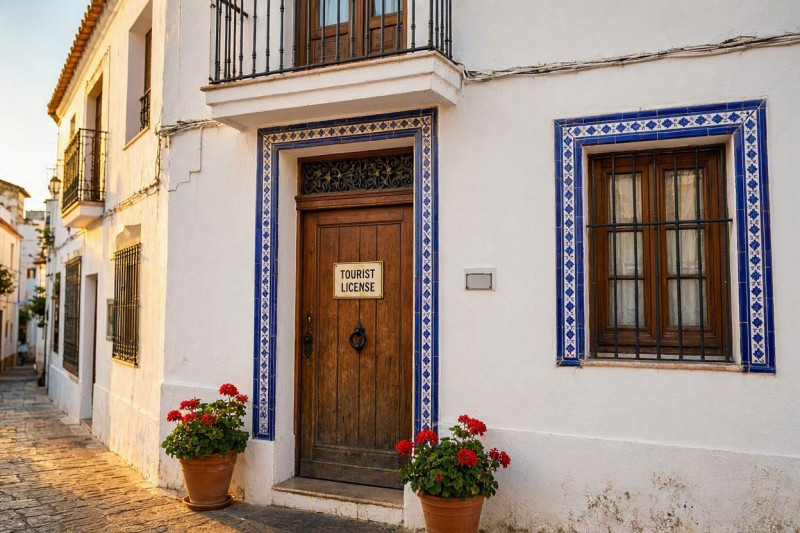
ANDALUCIAN TOURIST LICENCES – WHAT’S THE REAL STORY?
Tourist licences haven't disappeared. Spain hasn't banned holiday rentals. And having an existing licence doesn't necessarily mean that nothing has changed.
If you own, are buying, or are thinking of selling a property in Andalucía, you could be forgiven for being thoroughly confused about tourist licences.
During the last couple of years we have heard everything from:
“Tourist licences are no longer being issued.”to “Every holiday rental now needs a national Spanish licence.”
and even: “If a property already has a tourist licence, you can automatically continue renting it forever.”
None of those statements tells the whole story.
There have been some important changes – both in Andalucía and nationally – but the situation is considerably less dramatic than some of the headlines suggest.
So, what is actually going on?
First things first: Andalucía still has tourist licences
Perhaps the biggest misconception is that Spain introduced a new national tourist licence which replaced the existing Andalusian system.
It didn't.
Tourist accommodation in Andalucía continues to be regulated principally by the Junta de Andalucía, and properties operating as Viviendas de Uso Turístico (VUT) continue to be registered with the Registro de Turismo de Andalucía.
For a normal VUT, the process is based upon submitting a Declaración Responsable confirming that the property complies with the requirements for operating as tourist accommodation.
Once correctly registered, the property receives its Andalusian tourism registration number – typically something along the lines of:
VUT/MA/xxxxx
That system still exists.
What has changed is that obtaining – and keeping – that registration is now more closely connected with whether the property is actually permitted to operate as tourist accommodation under other applicable rules.
The important change in Andalucía
The major change came with Decree 31/2024, which substantially revised Andalucía's rules governing Viviendas de Uso Turístico.
One of the most important points is surprisingly simple:
A tourist property must comply with the applicable municipal planning regulations.
When a VUT is registered, the Junta communicates that registration to the relevant Ayuntamiento.
This matters.
Historically, many owners regarded obtaining a VUT number as almost entirely an administrative tourism procedure.
Today, it is increasingly important to look at the property itself.
Is the house legally recognised?
Does its use comply with the local planning regulations?
Are there municipal restrictions on tourist accommodation in that location?
Is the accommodation being offered consistent with the legally recognised dwelling?
These questions can matter just as much as the tourism registration itself.
A VUT number is not a certificate that the property is legal
This is probably one of the most important myths to dispel.
MYTH:
“It has a tourist licence, therefore the house must be completely legal.”
REALITY:
Not necessarily.
The tourism registration and the planning/legal status of the property are related, but they are not the same thing.
A property may have obtained a tourism registration while still having discrepancies between the house as it physically exists and the description appearing in the Escritura, Land Registry, Catastro or municipal records.
This is particularly relevant with older village and country properties where extensions, terraces, pools, guest houses or outbuildings may have been added over many years.
A VUT registration should therefore never replace normal legal and planning due diligence when purchasing a property.
Then came Spain's National Short-Term Rental Register
This is where much of the confusion began.
Spain introduced Real Decreto 1312/2024, creating a national system for short-term accommodation advertised through online platforms.
From July 2025, owners were told that properties offered through short-term rental platforms would require a Número de Registro Único de Arrendamiento, obtained through the Property Registry or Movable Property Registry.
Suddenly owners who already had perfectly valid Andalusian tourist registrations were being asked to obtain another registration number.
Not surprisingly, many people assumed this was a new national tourist licence.
It wasn't.
The Andalusian tourism registration continued to exist separately.
The national registration was essentially intended to provide a centralised system for identifying and monitoring short-term rentals advertised through online platforms.
And then things became even more interesting.
The National Register was successfully challenged
In May and June 2026, Spain's Supreme Court issued a series of judgments concerning Real Decreto 1312/2024.
The Court annulled the provisions establishing the procedure requiring properties to be registered through the Property Registry or Movable Property Registry in order to obtain the national registration number needed to advertise short-term accommodation through online platforms.
In other words, a significant part of the national registration system that owners had spent much of 2025 trying to comply with was struck down.
This is an important distinction.
The Supreme Court did not abolish tourist licences.
It struck down key provisions of the national short-term rental registration procedure.
Your Andalusian VUT registration is an entirely different matter.
So do I still need an Andalusian tourist licence?
If you are operating accommodation which falls within the definition of a Vivienda de Uso Turístico in Andalucía – yes.
The Junta currently considers a property to be operating habitually for tourism purposes where tourist accommodation is advertised or where the service is provided on one or more occasions during a year for periods which together exceed one month.
There are, however, important exclusions.
For example, a property rented to the same tenant continuously for more than two months is not treated as a VUT under these rules.
And rural tourist accommodation can fall under a different regulatory regime altogether.
That last point is particularly relevant in inland Andalucía.
“My house is in the countryside, so I just need a VUT.”
Not necessarily.
This is another common misunderstanding.
Properties situated in the rural environment may fall under Andalucía's separate regulations governing Turismo en el Medio Rural, rather than the standard VUT regime.
Whether a particular finca should operate as a VUT, a Casa Rural, another form of rural tourist accommodation, or simply under a seasonal residential rental arrangement depends upon the property and the nature of the activity.
For buyers purchasing a country property specifically because they intend to generate holiday rental income, this should be investigated before buying, rather than afterwards.
And what does a VUT property actually have to provide?
The current Andalusian regulations are more detailed than many owners realise.
Among other requirements, there are minimum space standards.
Generally, a VUT must have at least 14m² of constructed principal residential area per authorised guest, with a minimum principal residential area of 25m².
Capacity is also limited.
A complete dwelling can accommodate a maximum of 15 guests, while accommodation rented by individual rooms is limited to six, with additional limits applying per bedroom.
Properties accommodating more than five guests require two complete bathrooms, and those accommodating more than eight require three.
There are also requirements concerning ventilation, window shading, beds and mattresses, bedding, first-aid equipment, guest information and appropriate heating and cooling.
So simply having a registration number isn't the end of the owner's responsibilities.
“I bought the house with a tourist licence, so the licence belongs to the house.”
This one needs particular care.
When purchasing a property advertised as having a tourist licence, buyers should not simply rely upon the registration number appearing in an estate-agent advert.
The registration should be checked.
Who is the registered operator?
Is the property still actively registered?
Does the registered capacity correspond with the house being sold?
Does the physical property correspond with the property documentation?
Are there restrictions imposed by the Ayuntamiento or Community of Owners?
And what procedure will be necessary following the change of ownership or operator?
The ability to continue operating tourist accommodation can add genuine commercial value to a property – but only when that position has been properly verified.
Does this mean tourist rentals are being banned in Andalucía?
No.
But the direction of travel is clear.
There is considerably more scrutiny of tourist accommodation than there was five or ten years ago.
The Junta de Andalucía regulates the tourism activity.
Municipalities increasingly have a role through planning and local regulations.
And national and European legislation is creating greater transparency around accommodation marketed through online platforms.
That is very different from saying that holiday rentals are being abolished.
So what should a buyer do?
If holiday rental income forms an important part of your reason for purchasing a property, treat the ability to operate tourist accommodation as part of your legal due diligence.
Don't simply ask:
“Does it have a tourist licence?”
Ask:
“Can I legally continue operating this particular property as tourist accommodation after I buy it?”
That is a much better question.
Likewise, sellers who have an existing VUT registration should make sure their documentation is in order before marketing the property as having an established tourist rental business.
THE BOTTOM LINE
Despite some rather alarming headlines, Andalucía has not abolished tourist licences.
The Andalusian VUT system remains firmly in place.
What has changed is the regulatory environment surrounding it.
The national short-term rental registration introduced in 2025 created considerable confusion and an additional layer of administration, only for key parts of that registration procedure to be annulled by Spain's Supreme Court in 2026.
Meanwhile, Andalucía has strengthened its own VUT regulations, municipalities have become more important in determining whether tourist accommodation is permissible, and new tourist rentals in buildings governed by the Horizontal Property Law can require approval from the Community of Owners.
So the real story isn't:
“You can't get a tourist licence anymore.”
Nor is it:
“The national register has been cancelled, so we can forget about tourist licences.”
The reality is much more straightforward:
Tourist accommodation remains perfectly possible in Andalucía – but the property, the location and the proposed activity all need to comply with the rules that apply to them.
And when buying a property with an existing tourist licence, that licence should be checked rather than assumed.
For buyers looking for a home, country property or investment in Andalucía, good due diligence at the beginning can avoid some very expensive surprises later.


